With the Houston Livestock Show and Rodeo coming up March 1-20, including Go Tejano Day on March 13, I figured I should try to understand the complicated Regional Mexican radio scene in the 6th biggest U.S. radio market.
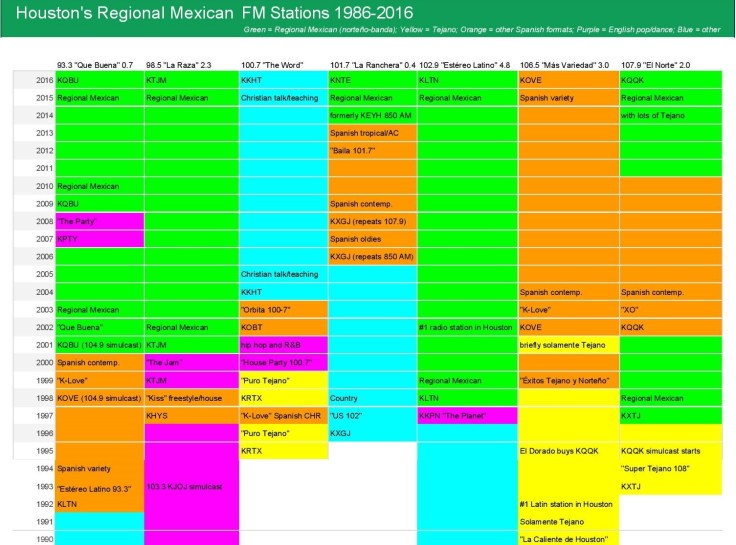
Look, I made a chart! Stations are listed across the top — frequency, station nickname, rating for the 4th quarter of 2015 — with the most recent call sign associated with that frequency just below, in the 2016 row. The chart begins with 1986 at the bottom; as you travel up through the years, you can see when new call signs take over specific frequencies.
OCTOBER 5, 1989: GERARDO ORTIZ IS BORN (That’s just for reference, and because this .jpg was hard to format.)

When NorteñoBlog surveyed Chicago´s Regional Mexican radio scene last year, it was a straightforward project — I traced the timelines of the three major stations in our market. Not so in Houston. As you can see from the above chart, Houston’s Mexican music fans have enjoyed an abundance of choices over the past three decades. They’ve also endured a confusing tangle of buyouts, simulcasts, and call signs changing frequencies, along with the national boom and bust of a vital regional style: Tejano.
Today non-Texans might have trouble understanding Tejano’s importance to the Lone Star State. After all, Chicago didn’t get our first all-Mexican station until 1997 — the same year KXTJ became Houston’s first station with a norteño focus — by which time Tejano was quickly losing spins to norteño on U.S. radio. In the previous decade, Tejano hadn’t merely been an important regional style; it had been central to Hispanic radio listeners across El Norte, and central to the identities of millions of Texas Latinos. The tragedy of Selena’s death in 1995 was a harbinger and probably a cause for a wider sense of loss — the loss of Tejano identity resonating with a broader populace. As we’ve seen from the outcry when the Houston Rodeo schedules norteño bands on its popular “Go Tejano Day,” Tejano music is more than a nationwide fad that dried up. It’s not duranguense. Tejano identity is a powerful and distinct thing, with music as one of its main expressions, and for a brief period of about a decade that musical identity was crucial to America’s understanding of Latinos.
And then all of a sudden it was replaced by a bunch of damn corridos and tubas. You can understand why Tejano fans’ nostalgia would take on a new intensity.
But that oversimplifies the matter. Let’s look at some of the chart’s high points. As you do, keep in mind that I’ve never been to Houston and I probably got some things wrong, so I’ll welcome your comments and corrections. Continue reading “A Guide to Regional Mexican Radio in Houston”


 NorteñoBlog