Four new tunes from the NorteñoBlog milieu join this week’s charts. At the top of the heap, cracking the top 20 on the Hot Latin chart, is the latest mind numbing ballad from Banda MS, “A Lo Mejor.” You’re forgiven if you’ve forgotten “A Lo Mejor” since we last encountered it, because IT NUMBED YOUR MIND. But the video is entertaining twist-ending novela fare; you can tell it cost a lot, and that nobody shooting the video could remember the song they were supposedly depicting, either.
The other three new songs, all near the bottom of the Regional Mexican airplay chart, sound better to varying degrees. Arrolladora’s “Confesion” is faster and more minor-keyed than much of their recent output. Faint praise, but then, it’s been a while since these guys left an impression. Los Tucanes’ corrido “Suena La Banda” stomps along with guest stars Código FN. Several several members of Código are confined to standing around singing in their sparkly jackets without their instruments, but their tubist gets in some good licks, and both bands’ drummers find a way to coexist. Even better is the magic changes title track from Vete Acostumbrando, the latest album by psychedelic corridista and family man Larry Hernández. Lots of crammed-in words and snarling, which beats Larry attempting to croon.
It’d be this week’s Pick to Click if NorteñoBlog wasn’t a total sucker for Tito “El Bambino” and his attempts to sound like a more romantic Pet Shop Boys. Like the aforementioned Banda MS song, “Como Antes” enters the Hot Latin top 20. Unlike Banda MS, Tito plays majestic reggaeton synth pop with pounding drums and low voices comically interjecting things like “MAMACITA” every so often. Great vocal harmonies, too. The acerbic voice of Zion &/or Lennox appears midway through to scrape the plaque from your heart.
Desafortunadamente, manejé a St. Louis cuando mis colegas a The Singles Jukebox escribieron sobre el cantante favorito de NorteñoBlog, Julión Álvarez, y su canción “El Amor De Su Vida.” Lloré lágrimas amargas. Julión Álvarez lloró lágrimas amargas también, porque ese es su trabajo.
Brad Shoup:
You know, I gotta stop weighing the vocals against the intro. The brass arrives like waves of reinforcements before a defense is even established, and that’s enough. Álvarez passes off shakiness as emotion, but he’s rescued time and again by a sympathetic rhythm section and a boisterous set of horns.
Sr. Shoup, Julión Álvarez es auténtico en su emoción y su “shakiness,” su shakiness es muy hermoso, y tú, Sr. Shoup, deberias buscar pequeñas cantidades de emoción en tu corazón… SI ES QUE EXISTEN. :):)
(“El Amor De Su Vida” = NO VALE LA PENA, btw. Sin embargo…)
Fortunadamente volví a casa para escribir sobre El Komander y “Malditas Ganas”:
Sr. Ríos isn’t quite the last man standing from El Movimiento Alterado, the over-the-top genre of horror corridos milked dry by L.A.-based Twiins Enterprises. He is, however, the only Twiins artist who can reliably command a million quick Youtube hits, so that’s what he does: he’s released a single a month in 2015, none indulging in the old ultraviolence, each its own special variety of ramshackle. Komander can’t exactly sing, as you discover when you encounter one of his ballads, an uncomfortable experience like stumbling across a jalopy wheezing to its final resting place in a junkyard. But he excels at plaintive self-referential ramshacklery like this, his January single; the whirligig swing-your-partner-into-the-walls ramshacklery of “Fuga Pa’ Maza,” his March single, is even better. This is all an illusion; his band is deceptively tight, the aural equivalent of the old wobble-the-pencil-so-it-looks-rubbery trick. All this ramshactivity has been… accumulating up to the release of July’s album, sure to contain the most virtuosic collection of mouthpiece farts the world has ever heard.
Two years ago, the last time Banda El Recodo released an album, I wrote, “Like happy families and episodes of The Waltons, all Banda el Recodo albums are alike. When you play one, you’re assured 40 minutes or so of ace arrangements and pleasant tunes in a variety of styles.” I haven’t heard all of their new album, Mi Vicio Más Grande (Fonovisa), but I may have to go back on my word. For one thing, it’s only 30 minutes long! Possibly inspired by the rambunctious spirit of their title song, a previous Pick to Click, they’ve decided to dispense with this album quickly with only 11 songs, down from the 19-song high water mark of 2009’s Me Gusta Todo de Ti. But that’s OK, NorteñoBlog likes short albums. Worse news is that aside from “Vicio,” the songs I’ve heard suck. “Todo Tuyo” may have been a hit but it defines the idea of a nothing ballad, sucking brain cells into its void. Nor do the other two advance tracks seems designed to stick, whether it’s songwriter Freddy Osuna enjoying “La Miel de Su Saliva” or the sage songwriting team of Luciano Luna, Joss Favela, and Miguel Angel Romero skipping through “De Haber Sabido.” By now bandleader Alfonso Lizárraga has proven he can simply spin Recodo’s wheels, releasing an album with the requisite two hits (“Vicio” has gone top 20 on the Hot Latin chart) to keep the brand going.
NorteñoBlog has previously been bewildered by the prolific career scope of psychedelic corridista and family man Larry Hernández, whose new Vete Acostumbrando (Sodin/Fonovisa) dropped two weeks ago. In contrast to the somewhat unofficial “got purp” feel of his last album 16 Narco Corridos Vol. 2, Vete is an official hitmaking release full of romance and obsession and a Gerardo Ortiz duet. At only 10 songs (NorteñoBlog cheers!), most of which are good, none of which stand out, it’s less of a chore than either new album by Ortiz or Recodo. Hernández doesn’t innovate his genre like Ortiz, and he doesn’t even sing as well — listen to the fine quartet ballad “Ya Me Cansé” and you might think he’s coughing up his lyrics. But he zips through his music with unabashed and unpretentious pleasure. On my loosely ranked list of favorite albums of 2015, Hernández sits next to Kid Rock, which seems about right. Plus my awesome librarian Gloria likes him. I’ll confer Pick to Click status upon the banda firecracker “Aferrado Corazón,” which features Hernández not quite reaching his high notes in a very appealing way.
El Komander yadda yadda another single blah blah blah not really trying any more but that’s integral to his charm yak yak yak. But — what’s this? — Sr. Riós seems pretty invested in his sixth (?) official single in as many months. It’s called “El Elegante,” it’s fast banda and barely a song, but it does herald his forthcoming album for Twiins Enterprises, Detrás Del Miedo. Due July 7th! I’d say reserve yourself a copy, but let’s face it: such effort would hardly keep with the spirit of Komander’s recent loosey goosey output. Although to be fair, the guy’s released a single per month in 2015; what have I done?
That sort of existential uncertainty hangs heavy over “Wildfires,” the new Mariachi El Bronx single on ATO. Wait. No it doesn’t. Mariachi El Bronx sounds like fucking Fastball. Let’s be clear here: NorteñoBlog is not categorically opposed to U.S. pop appropriations of regional Mexican styles. More such appropriations might be welcome, because horns and strings sound great on the radio, and the people of El Norte need to learn these styles. The members of Mariachi El Bronx have doubtless studied more mariachi music than I have. Some of them are Latino. They play their instruments well. But let’s also be clear: they’re not playing mariachi music. They’re using mariachi as a gimmick to sell tickets to indie rock shows, same as Cake uses a trumpet. (Sometimes I like Cake.) If white hipsters go to Mariachi El Bronx shows to gawk at music that’s “cute” or “indigenous,” or if white hipsters leave Mariachi El Bronx shows thinking they suddenly know something about mariachi music, I suppose that’s the white hipsters’ problem, but I wish I had more confidence in Mariachi El Bronx to combat the problem. Ultimately though, I’m ragging on Mariachi El Bronx because of my longstanding disinterest in rote indie rock songs. (Plus, the lead Mariachi sings with a tenth the authority of George Strait; but then, don’t we all.)
When Pitbull someday releases a career-spanning greatest hits album, it’ll be a monster. He’s got one hits album already: 2012’s Original Hits compiled his early stuff from TVT records and it looks good (I confess I haven’t heard all the songs), but since he released it in the midst of the Planet Pit/Voli Vodka world takeover, most of the world outside the 305 area code overlooked it. NorteñoBlog doesn’t often cover Pitbull because he has about as much to do with regional Mexican music as Rita Moreno does. (I confess I have even LESS of a connection to the format, but here we are.) But since he is possibly the most charming man on the planet — he needs to be loved slightly more than everybody else does — I will share my theory of Pitbull hits:
There are two tiers of Pitbull hits. The top tier includes such monster EDM smashes as “Timber,” “Give Me Everything,” and “Time of Our Lives,” and these songs are pretty good, just as the Planet Pit album was pretty good. That’s disc one of our hypothetical career spanning compilation. But the second tier, our hypothetical disc two of smaller hits… THAT’S where Pitbull hides his gold. I’m talking stuff like last year’s #23 hit “Fireball,” his astounding Ying Yang Twins feature “Shake” (included on Original Hits), 2010’s phenomenal, bilingual, featuring-Lil-Jon-and-everybody “Watagatapitusberry,” and the Pick to Click that climbs this week to #25 on Hot Latin, “El Taxi” featuring Sensato & Cuban oral sex freedom fighter Osmani Garcia. (“Chupi Chupi” was the too sexy song in question.) It’s really Garcia’s song — he originally received top billing and it’s more than a year old at this point, with 111 million Youtube views, but I assume it’ll appear on Pit’s forthcoming Spanish album Dale. “El Taxi” is lowdown and slinky. It features car horns beeping. I mean, come on.
Imagine trying to live up to the legacy of Jenni Rivera. There’s never been anyone like her. Her personality — commanding, ribald, sexy, romantic, hilarious — burned through every note of her music. Her songs became inseparable from the public persona she shared on TV; and her sharp business acumen, the will that drove her to succeed, became integral to hearing her. Her success in a male-dominated field added to her complexity. She made herself into an object of longing and fear to both women and men. To aspire to Rivera’s level of command was to welcome the terror of never getting there.
At Billboard Angie Romero offers a track-by-track analysis of Chiquis Rivera‘s new album Ahora (Sony), along with an interview. Not having read Chiquis’s tell-all memoir, NorteñoBlog isn’t fully up to speed on all the difficulties of growing up with Jenni Rivera for a Mom. But I fully sympathize with the daunting task of needing to make music in her wake. “‘I don’t think that I sing like Celine Dion, but I’m not a horrible singer,’ Chiquis tells Billboard. ‘I was watching a video the other day of my mom when she was first starting. She grew into this monster onstage, she really dominated it, but it wasn’t always like that. People forget that.’” Exactly! Chiquis has a fine voice and there’s plenty to like about her songs, especially fast ones like the singles “La Malquerida” and “Completamente.” She gets into some swanky electro-pop like “Paloma Negra,” a duet with Julio Reyes that also serves as a backhanded tribute to Mom (Romero says Rivera previously dedicated the Mexican standard to Chiquis after they had a major falling out). Chiquis’s music stands in Rivera’s unavoidable shadow, but it frequently acknowledges that shadow, a Jenni hallmark: don’t try to separate life and art! And in her forward-thinking mix of banda and pop, Spanish and English, Chiquis points her own way out.
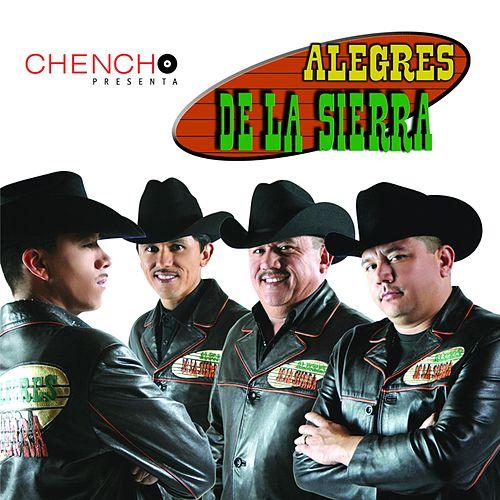
Last week NorteñoBlog noted that, when Los Cuates de Sinaloa were getting popular about a decade ago, Billboard hailed their guitar-based “musica de la sierra” as one of Mexico’s “new sounds” to keep an eye on. In the same milieu were Los Alegres de la Sierra, another family band who, from the looks of my hasty research, never made the jump to a major label but branched out musically just like Los Cuates did, adding members and instruments. Their self-released 2012 album Lagrimas En La Sierra is chipper accordion quartet stuff, new to streaming services, and I’m partial to “No Podrán.”
Similarly chipper and altitudinally minded, Los Alegres del Barranco have released a new single, the corrido “El Chino Piloto” (Hyphy). It’s chock full of fatalistic loneliness and helpful radar-evasion tactics, and its repeated eight-bar melody will dig a six-inch barranco through the middle of your skull. Continue reading “¡Nuevo! (starring Los Alegres, Los Alcapones, y más)”→
The mystery is solved! Allmusic appears to have acquired a physical copy of Hoy Mas Fuerte the same time NorteñoBlog did, and we’ve learned that Ortiz drew his small band from the usual stable of Del Records session pros: Pablo Molina on tuba, Aaron Gonzalez on bass, Lorenzo Fraire Reyes on bajo sexto, and Luis Navarro on drums. But Allmusic did omit some crucial players, notably the guy who most owns the sound of Fuerte: accordionist Marito Aguilar. Fuerte isn’t necessarily VALE LA PENA, but it’s worth hearing at least once for Aguilar, whose fingers are all over the place and constantly coming up with new ideas. He’s played with Ortiz on previous albums; he’s played on good albums by Regulo Caro and Adriel Favela; and he’s been one of the few reasons to pay any attention to Luis Coronel.
If you get excited by fly-on-the-recording-studio-wall videos and scenes of professional musicians overdubbing and “punching in,” you are to be pitied above all others you should totally watch this video of a session for Ortiz’s 2012 album, El Primer Ministro.
NorteñoBlog’s other discovery: “¿Por Qué Terminamos?”, the only Fuerte song I walk around humming, the one that sounds like a Luciano Luna ballad, IS IN FACT a Luciano Luna ballad. (Luciano Luna and Joss Favela, to be exact.)
Say what you will about the new Calibre 50 ballad — and no, I cannot prove that some nefarious Disa executive forced them to play the song while submerged in gelatin, although the first time I watched the video I thought the music had been screwed and chopped — but at least it knocked their previous ballad “Contigo” off the chart. (Don’t worry, “Contigo” is still huge in El Norte.) In fact all the new Mexican radio hits this fortnight are ballads, which makes Picking to Click a more difficult proposition than usual. But NorteñoBlog is not completely devoid of romance! NorteñoBlog knows the desires that wrack the heart! And you know who else knows how to rip out his heart for all to see? German Montero, that’s who! So give a listen to “Me Seguirás Buscando,” where Montero promises to keep searching… and searching… to provide you with complete satisfaction. Judging by his overwrought performance, the search might entail self-strangulation and vocal nodes, but if that´s what it takes…
In El Norte chart news, El Komander goes top 10 Hot Latin for the third time with “Malditas Ganas.” Billboard also reports that his ballad “El Papel Cambio,” which we encountered on the Mexican charts earlier this year, is lurking down in the U.S. 40s. The U.S. seems to lag a few months behind Mexico in our love for El Komander songs. NorteñoBlog has no ready explanation for this, since it´s certainly not true of every artist — see both countries´ immediate embrace of Recodo´s “Mi Vicio Mas Grande.” Komander does seem to do better with streaming than he does with radio play, so maybe his more ramshackle sound is a tougher sell for U.S. radio programmers? Continue reading “Who’s On the Mexican Radio? 5/29/15”→
The song features accordion, not always a given with Los Cuates, who started out with just two guitarists and a bassist. Well, technically they started with just two guitarists…
1998: Two 14-year-old guitar-playing cousins from Sinaloa, Nano y Gabriel Berrelleza, cross the border from Mexico into Arizona. After living homeless and busking for a couple months, one day they show up at a Phoenix nightclub owned by musician José Juan Segura. Segura tells Billboard,












 NorteñoBlog