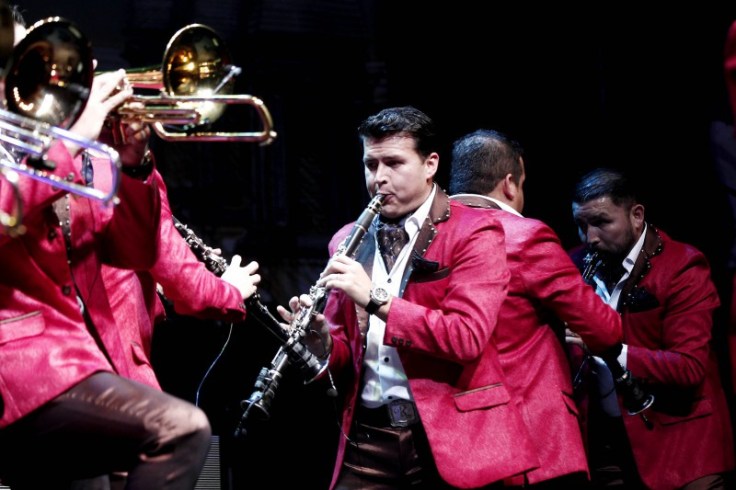
Multiple news outlets have reported that 42-year-old singer José Alberto Cervantes Nieto, aka Beto Cervantes of the band Explosión Norteña, has died. At around 11am Thursday morning, he was shot at the corner of calle Art. 27 and calle Michoacán in the Constitución colony of Rosarito, Baja California.
As Manuel wrote almost a year ago, Cervantes has been attacked before, probably because he and his band have (allegedly) been cozy with a cartel and cartels (most definitely) shoot people. Indeed, Explosión’s latest album, De Regreso Y Con Bastante Decisión (ARS), has sparked several rounds of Hasty Cartel Googling as NorteñoBlog tries to figure out corrido protagonists like El Flakito and El XL. One rumor suggests Cervantes was killed by a rival cartel when he refused to write them a corrido — a courageous move, if it’s true, when your prospective employers brandish guns and offer you up to $50,000 for a day’s work. Continue reading “Beto Cervantes D.E.P.”→
Juan Gabriel has been trading on his lifelong success for the past couple years, but you can’t say he was coasting when he died last Sunday. On August 19th he’d embarked on a tour, playing his final show a week later at the Los Angeles Forum, capacity 17,500. In some ways he was more popular than ever. On Billboard‘s Top Latin Albums chart, he had just scored a record fourth #1 album in the past 18 months with Vestido de Etiqueta por Eduardo Magallanes, an album of ornate remakes of his old songs. (The new intro for the already elaborate groover “No Quiero” now approaches full blown symphonic pomp rock — you expect to hear Christopher Lee start talking about dragons.) The other chart toppers included the two volumes of Los Duo, where Gabriel sang duets of his catalog with a panoply of pan-Latin stars from across different genres.
That’s where NorteñoBlog caught up with Gabriel: in a video that’s easily as mind-melting as any by Peter Gabriel, a new version of JuanGa’s 1980 12-bar-blues “La Frontera.” Crossing whatever musical borders you care to name, it features the continent’s best singer Julión Álvarez, the new Zelig of reggaeton J. Balvin, a four-bar breakdown for tuba and funk guitar, an impeccably tiled studio wall, a whole lotta eyeliner, and an uncredited gospel choir. (“I knew that if God was listening, he was listening to African American music,” Gabriel once told the LA Times.) You owe it to yourself:
But keeping JuanGa’s story in the present does a disservice to a man whose life and music affected millions of people. He was an unfathomably prolific writer, like Dolly Parton or Prince, and just as beloved a performer of his own material; a robust challenger of his fans’ sexual hang-ups, like Dolly Parton and Prince with their own fans; and he could transform regional genres into universally beloved national pop music, like — you guessed it — Bruce Springsteen. (Also Dolly and Prince.)
Much has changed on the Mexican airwaves since NorteñoBlog last tuned in over a month ago. The former #1 song, a heartbroken sob story of romantic grief and brassy bereftitude by Arrolladora, has given way to a different heartbroken sob story of romantic grief and brassy bereftitude, this time by Banda MS. And everyone knows that Arrolladora ballads are ace slow jams with rhythm sections full of coiled tension, while MS ballads drip like the discharge from festering sores. It’s all there in the music!
Further down, two Remex Records acts have replaced themselves on the radio with remakes. The more notable is ace flarer-of-nostrils Edwin Luna and his banda of second fiddlers, La Trakalosa. Given our troubled and uncertain times on both sides of the Great Wall of Trump, NorteñoBlog finds comfort in watching Luna grimace his way through another extravagant video meant to highlight his perennially nascent acting chops. (He acts in both color and black and white!) No hay nada nuevo bajo el sol. “Dos Monedas” was previously a hit for Ramón Ayala, and it was written by Jesse Armenta — You know him! He wrote some political barnburners for Los Tigres, including “El Circo,” thus winning himself a chapter in the book Narcocorrido — and it’s another heartbroken sob story.
Only this sob story is not at all romantic; it’s closer to “The Christmas Shoes” or some shit. The narrator is an abusive drunk. One cold and wintry night he sends his son out to beg for money to support the family booze fund. The next morning he opens the door to find sonny boy dead, both frozen and starved, holding in his small frozen starved hands the “dos monedas” of the title. All our children should be so dedicated! The narrator, no fool, sees a moral in this story, as does Edwin Luna, whose unconvincing portrayal of the drunk ends by approximating sadness. But Luna over-emotes his songs like nobody else, a good thing, and the arrangement makes this the cheeriest tune about filicide since “Sweet Child O’ Mine.” ¡VALE LA PENA! Continue reading “Who’s On the Mexican Radio? 8/26/16”→
It is the longstanding position of NorteñoBlog that the puro sax styles of Chihuahua and Zacatecas would improve with the addition of more terrible “sax” puns in the titles. First things first: La Maquinaria Norteña, the Zaca-huahuan/New Mexican quintet that stands astride this genre like a saxophone colossus, has just released its ninth-I-think album in a decade, Generación Maquinaria Est. 2006 (alternate title: Saxo de Cumpleaños). Thanks to some major label Fonovisa distribution, and because they’re on the scene like máquinas saxuales, they sold 3,000 copies of the album its first week. That was enough to debut at #1 on Billboard‘s Latin Albums chart.
Agosto may be slow, but Maquinaria isn’t. Generación skips along in typical unrelenting fashion; the polka beats are sharp and nonstop, brothers Keith and Rory Nieto fill nearly every instant with well-plotted sax/accordion ideas, and Ivan Gutierrez winds his bass through the proceedings like a buoyant breeze. You can hear all this on their current hit “Todo Es Diferente” (subtitle: “… Excepto El Saxo”), but NorteñoBlog notes two other standouts. Keith’s original “El Corazón No Miente” throws in a slamming surprise ending, with electric guitar and drums bashing away; and singer Sergio Soto contributes a new breakneck waltz that sounds old, “Cosquillitas” (i.e., “¡¡¡Tickle Sax!!!”). Maquinaria’s quality is a difference of degree: the group simply sounds fuller, richer, and more distinctive than other puro sax bands. Once you go Maq, you’ll never go back.
The world waits, selfie sticks and hair product poised and ready, for 20-year-old heartthrob Luis Coronel to release his next album. Uncharacteristically, NorteñoBlog will cut the guy some slack. Fielding a lawsuit from a former producer and going reggaetón would slow down anyone’s career. The last time I went reggaetón, the local barnyard animals went unmasturbated for months. It was chaos.
Afortunadamente, the job of “young dreamy norteño singer with enviable hair” is not so hard to fill, and this week’s charts have two hopefuls squeezing through the Coronel-shaped void. At #20 on the Regional Mexican radio chart is L.A.’s teen corridero Cheyo Carrillo, who rarely settles for the typical fade-with-fauxhawk look, instead coaxing volume and body with frightening abandon. As a pre-teen, his accordion skills landed him a gig with Los Bukanas de Culiacán, and then with El Komander. This got him noticed by Komander’s label bosses and noted amoral purveyors of candy everybody wants, the Valenzuela Twiins. NorteñoBlog slept on last year’s self-titled debut album (on Twiins-affiliated La Disco Music), which included an authoritative version of Komander’s “Soy de Rancho,” but desafortunadamente I haven’t made the same mistake with this new single, the romantic banda snooze “No Es Normal,” released by Fonovisa and written by industry lifer Adrian Pieragostino. The video features a young, apparently dorky woman who wears glasses but is secretly hot, and lots of slow motion chewing. The song features some rote brass charts. Es normal, pero NO ES VALE LA PENA. Continue reading “Attack of the Teen Idols (Desfile de Éxitos 8/13/16)”→
Thanks to you, a loyal coalition of corrido heads and puro sax devotees, NorteñoBlog enjoyed its most-clicked month yet in julio. Here are the posts that got the most attention, both current articles and old ones:
3. Who’s On the Mexican Radio? 6/23/16
La Iniciativa and Banda Los Recoditos team up for a tongue-twisting tune about wingmen and the women they share at the club.
It’s been a few months since NorteñoBlog checked in with Hyphy Music Inc., the Fresno, California-based indie label devoted to (mostly narco-)corridos. Despite the label’s bud-bating logo “Kush Style,” adopted by owner Jose Martinez to distinguish his label as a mellow alternative to the gory Movimiento Alterado, I’ve previously chided the label on its lack of a distinct brand identity. (Seems like a weird thing to care about, I know.)
Recently, though, Martinez seems to have settled into a niche: His acts are all about HUSTLE. They play fast and work hard, and they sing about playing fast and working hard. Just like in rap, where the nonstop grind of the gangster becomes a metaphor for cranking out endless musical versions of that selfsame metaphor (a meta-metaphor?), Hyphy’s bands embody the gritty work ethic of the narcos they chronicle. That they sometimes sing about other subjects is the exception proving the rule. This extreme focus can lead to repetitive music, sure; but at their best, Hyphy acts create exciting micro-variations driven by morally fraught jitters. They know that, if their energy flags, a rival will quickly step in to fill the void. It’s music as an energizing and sometimes exhausting fight for life.
Un ejemplo: the accordion-slinging corridero Martin Patrón (aka Martin Lopez “El Patrón”) has just released his debut album Trap Corridos, hustling another term of art from U.S. rap. It comes only a decade and change after T.I.’s Trap Muzik, but whatever; the word “trap” still has currency in this year of “Panda.” Also like “Panda,” my transcriptions of Sr. Patrón’s songs remain sketchy-to-nonexistent, but a round of Hasty Cartel Googling reveals “M100” is probably about a Sinaloa Cartel honcho, and “Hijo de Joaquín” is probably about El Chapo’s kid. (St. Louis pride being what it is, arguments for the late Joaquín Andújar, himself no stranger to hustle, will be entertained.)
So don’t invite Patrón to play Career Day at your local high school. But the music’s the important thing: an irresistible blend of spiky tuba/drum/sexto counterpoint, topped by Sr. Patrón’s accordion, alternately spitting out impressive flourishes and chromatic Jackson Pollock splatters. He’s a fine singer, too, with a rich and resonant voice. A couple Facebook comments suggest he sounds like the late Tito Torbellino. Check out the Pick to Click single “El de la Rueda” (not a Torbellino cover) and see if you agree:
Three so-so tunes replace three other so-so tunes on the Mexican radio chart this week — although to be honest, given the choice of Banda MS‘s new nondescript quiet storm “Tengo Que Colgar” or “¿Por Qué Me Habrás Besado?”, the duet by Edith Márquez and Julión Álvarez now leaving the chart, I’d choose the latter in a second. It’s a little showbizzy, but hearing those two voices locked in a tremulous battle for command atop a dancing tuba, ruthlessly interrogating one another’s kissing choices, I fear I’ve been underrating it. Sorry to see you go, Edith and Julión, you old limón labios! And what the heck, Pick to Click! This gesture may be too little too late, a bit like Senator Mark Kirk declining to endorse Donald Trump for president, but at least it’ll assuage my guilt.
Also new and nondescript is veteran ranchero de amor Pablo Montero (speaking of charros), at #15 with the promotional tie-in single to his real-life divorce, “Tú No Eres.” Montero hit the novela and music scenes back in the early years of this century, piercing souls with his smoldering gaze and equally smoldering voice. Sometimes mentioned alongside his fellow second-generation romantics Alejandro Fernández and Pepe Aguilar, his music career never hit the same heights as theirs, though he did work with the prolific producer and writer Rudy Pérez. His biggest hit was one such collaboration, 2002’s “Hay Otra En Tu Lugar,” which you’ll find either impossibly lovely or impossibly cheesy, depending on which stage of grief you occupy. Later in 2002 Billboardmentioned Montero had collaborated with Los Twiins, the California producers who’ve shaped the sounds of 21st Century banda and corridos as much as anyone, but I can’t figure out whether Montero released any music from those sessions.
Over on the “Spins” chart — which means it’s getting played by DJs a bunch, but not to big radio audiences yet — the tuba sextet Impacto Sinaloense scores with the romantic boast “Rompimos las Reglas”. It seems Impacto and their mujer are hooking up in covert fashion whenever and wherever circumstances will allow. Singer Alex Morales is understandably excited about this, leading his voice to fly free of the beat on the word “adrenalina,” a chorus hook so notable the band repeats the chorus the second time through — in a genre committed to brevity, it’s a lavish musical gesture. Although, like Impacto’s illicit hookups, the song still lasts less than three minutes. Continue reading “Who’s On the Mexican Radio? 7/26/16”→
Over at OC Weekly, Gustavo Arellano overrates the new album by Pepe Aguilar, No Lo Había Dicho (Equinoccio), calling it “an audacious mix of vallenato, pop, banda, and ranchera that lands more often than not.” NorteñoBlog respectfully disagrees with both value judgments expressed in that sentence.
In 2016, there’s nothing “audacious” about mixing up those styles of music — especially for Aguilar, who’s been doing so longer than his contemporary Beck, who made his reputation with purportedly audacious musical mixology back in the ’90s. (Who can forget the mariachi version of “Jackass”?) Even if we limit our search for audacity to Aguilar’s field — the intersection of pop and ranchera known to radio programmers as “romantic Mexican music,” says Billboard‘s Leila Cobo — the idea of crossing over is nothing new. And since artists as diverse as Juan Gabriel, Juanes, Chiquis, Helen Ochoa, and Natalia Jiménez have all recently mashed up “traditional” styles with pop, Aguilar’s music fits right in. Genre mixing is definitely welcome, and it’s still little-heard on regional Mexican radio (the format probably played more genre mashups during the ’90s electro-banda-and-Tejano heyday), but Aguilar’s music has plenty of company in the wider world.

 As Manuel wrote almost a year ago, Cervantes has been attacked before, probably because he and his band have (allegedly) been cozy with a cartel and cartels (most definitely) shoot people. Indeed, Explosión’s latest album, De Regreso Y Con Bastante Decisión (ARS), has sparked several rounds of Hasty Cartel Googling as NorteñoBlog tries to figure out corrido protagonists like El Flakito and El XL. One rumor suggests Cervantes was killed by a rival cartel when he refused to write them a corrido — a courageous move, if it’s true, when your prospective employers brandish guns and offer you up to $50,000 for a day’s work. Continue reading “Beto Cervantes D.E.P.”

 Further down, two Remex Records acts have replaced themselves on the radio with remakes. The more notable is ace flarer-of-nostrils Edwin Luna and his banda of second fiddlers, La Trakalosa. Given our troubled and uncertain times on both sides of the Great Wall of Trump, NorteñoBlog finds comfort in watching Luna grimace his way through another extravagant video meant to highlight his perennially nascent acting chops. (He acts in both color and black and white!) No hay nada nuevo bajo el sol. “Dos Monedas” was previously a hit for Ramón Ayala, and it was written by Jesse Armenta — You know him! He wrote some political barnburners for Los Tigres, including “El Circo,” thus winning himself a chapter in the book Narcocorrido — and it’s another heartbroken sob story.
 It is the longstanding position of NorteñoBlog that the puro sax styles of Chihuahua and Zacatecas would improve with the addition of more terrible “sax” puns in the titles. First things first: La Maquinaria Norteña, the Zaca-huahuan/New Mexican quintet that stands astride this genre like a saxophone colossus, has just released its ninth-I-think album in a decade, Generación Maquinaria Est. 2006 (alternate title: Saxo de Cumpleaños). Thanks to some major label Fonovisa distribution, and because they’re on the scene like máquinas saxuales, they sold
 Afortunadamente, the job of “young dreamy norteño singer with enviable hair” is not so hard to fill, and this week’s charts have two hopefuls squeezing through the Coronel-shaped void. At #20 on the Regional Mexican radio chart is L.A.’s teen corridero

 Un ejemplo: the accordion-slinging corridero Martin Patrón (aka Martin Lopez “El Patrón”) has just released his debut album Trap Corridos, hustling another term of art from U.S. rap. It comes only a decade and change after T.I.’s Trap Muzik, but whatever; the word “trap” still has currency in this year of “Panda.” Also like “Panda,” my transcriptions of Sr. Patrón’s songs remain sketchy-to-nonexistent, but a round of Hasty Cartel Googling reveals “M100” is probably about a Sinaloa Cartel honcho, and “Hijo de Joaquín” is probably about El Chapo’s kid. (St. Louis pride being what it is, arguments for the late Joaquín Andújar, himself no stranger to hustle, will be entertained.)
 Except — here’s respectful disagreement part 2 — this album is so bad.


 NorteñoBlog