
As promised, Edwin Luna and his perpetually nascent acting chops appear at #10 on this week’s busy Mexican radio chart with the giggle inducing “Fíjate Que Sí.” Actually, it might only induce giggles if you watch the video, let’s see here… [Listens to the song in another tab.] JAJAJAJA! Oh, Edwin Luna. You are an international camp treasure. The man draws out his singing and even his spoken interludes until the words congeal into a sticky mass. They say he aspirates agave nectar.
 Other entries previously lauded by NorteñoBlog include man-myth-legend El Fantasma at #17, and whirling fount of Terpsichore Marco Flores doing his devil dance at #19. At #14 we find the latest mariacheño-or-whatever romantic ballad from Christian Nodal, still sounding older than his teenaged years. In “Me Dejé Llevar,” the title track of his overrated 2017 debut album, Nodal laments getting carried away by passion for a mujer, which seems to have made him possessive and scummy. The music doesn’t sound like possessive scumminess; it’s his patented mix of dull, syncopation-free guitars with swoony horns, strings, and accordion. The video, though, is a primo cultural artifact. First we see the macho caballero with hat, cigar, and sturdy country mansion; then we’re whisked behind the scenes into some abstract phantasmagoria of amor, where the now hatless Nodal and a nearly naked mujer enact the ritualized dance steps of love inside a neon square, floating amid darkness. THE DARKNESS OF THE CABELLERO’S OWN HEART, you suggest? The Blog won’t argue with you, except to say: NO VALE LA PENA.
Better is the song at #11. “Sentimientos” is a likeable minor key cumbia from Alicia Villarreal’s 2017 album; it’s both a cover of Villarreal’s 20-year-old Grupo Limite hit, and a duet with her fellow mexicana María José. In both their studio rendition and in this live video, Villarreal and José work up a mariacheño head of steam like Nodal never dreamed. There’s just as much string/accordion swooning, but a much kickier beat and the knowing winks that appear when you find yourself in your 40s, mooning “Ahhhh…. FEELINGS.” Pick to Click!
 If these newfangled stylistic blends aren’t your thing and you long for some straight-down-the-middle chapado-a-la-antigua norteño, look no further than #20
Continue reading “Who’s On the Mexican Radio? (starring Alicia Villarreal, Christian Nodal, Joss Favela, y más)”

 Sierreño is no longer a novelty. The guitar + tuba-or-bass style is now as prevalent as its country cousins, banda and accordion-based norteño. Although the style has existed for decades, you can trace its popularity back to the 2015 death of young singer-guitarist Ariel Camacho, which cemented sierreño as both young people’s music and a vehicle for pop hits. Two Camacho-related bands — Los Plebes del Rancho de Ariel Camacho and Ulices Chaidez y Sus Plebes — appear below, as do established norteño/banda stars Gerardo Ortiz and Remmy Valenzuela, jumping on the sierreño bandwagon with corridos and romantic ballads. One of the year’s biggest breakout stars, man-myth-legend El Fantasma, scored a long charting hit with the guitar corrido “Mi 45,” in the process becoming one of California’s most streamed Latin artists.
 Gerardo Ortiz continues to dominate. You wouldn’t know it by looking at his album sales, but artistically, nobody in the genre had a better 2017. His sierreño-biting Comeré Callado album was a rebound from 2015’s disappointing Hoy Más Fuerte, with better songs and typically stunning band interplay. He was also featured on excellent norteño and bachata singles (see below), and notably did not release any
  Like Civil War reenactments and teen slasher movies, puro sax music will never die. The jaunty norteño subgenre, whose songs definitely do not all sound the same, continues to do several things well. It’s an excellent accompaniment to doing chores. Like freestyle, it pits bouncy uptempo music against bereft emo lyrics, to the benefit of both. And it pulls all kinds of other stuff — notably the huapango folk dance and alt-rockers Caifanes (see below) — into its deranged but happy orbit.
 I wish I liked mariacheño and socially conscious corridos more than I do. Christian Nodal released an excellent, career-defining debut single, “Adios Amor,” and then followed it up with a boring but well-reviewed mariachi album. Calibre 50 released a heartfelt sigh of an immigration story, “Corrido de Juanito,” that meant a lot to
  Where are all the women? I’m sorry to say, this is one area where the Blog seems to be getting worse, not better, and I’m not sure if it’s my fault or the industry’s. This year the Blog enjoyed singles by Alicia Villarreal (her album La Villarreal is way better mariachi pop than Nodal’s), Lucero, Diana Reyes, and Chiquis Rivera, but didn’t Pick to Click them, simply because there was better stuff those particular weeks. The latest countrified album from blog fave Laura Denisse was more of a chore than her last one, although it may be growing on me (and I just saw she has a Christmas album! Must research…). Los Horóscopos have been MIA lately. As Victoria ‘La Mala’ has
 At #9 we find the corrido quartet Enigma Norteño all hopped up on some profesor chiflado shit. “Batallándole (El Gordo Flubbers)” is a corrido celebrating the Good Life, occasioned by the illicit negocios of its narrator and shoved along by one of the Blog’s favorite hitmaking machines, La Séptima Banda. In Ernesto Barajas’s lyric, the narco narrator looks back on his hardscrabble origins serving hamburgers and selling Tercel plans, and waxes philosophical — “Sometimes you win and also lose yourself; today I won for being El Mono Verde.” For reference, recall Gerardo Ortiz’s kickass corrido
 But fans of medical metaphors and in-song death need not worry: in its place we have “Doctor” by Bronco, a smooth, synth-led grupero throwback, written by one of the dudes from pop duo Río Roma. Its story is simple and disturbing. The self-medicating, anhedonic narrator visits his doctor asking for a heart transplant because he can no longer love. The doctor assures our narrator that no cure exists, and instead offers to kill him. The narrator accepts. This bleak indictment of Mexico’s public healthcare system has somehow slipped past censors and cracked the top 10 of the nation’s radio chart, no doubt thanks to the seductive powers of its soothing cumbia lilt. Seasons don’t fear the reaper. You can be like they are. Come on, baby.
 Just ahead of the sickos in Bronco we find La Séptima Banda and their latest shot of banda pop cheer,
  At #18 we find José Manuel Figueroa with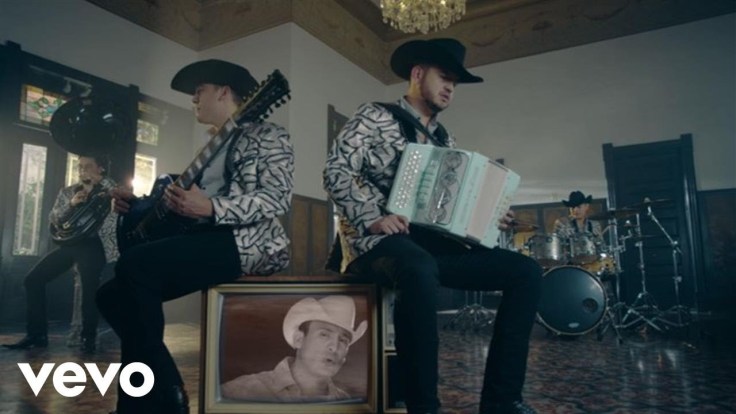

 The song, you see, plays on the traditional
 Resolve is not the Blog’s strong suit. Thus did I find myself washing dishes and listening to the latest in the series, Las Bandas Románticas de América 2017, 20 songs by 10 bands, only some of whom are “hitmakers” in the sense of “being heard anywhere outside this compilation.” I mean, I’m sure they tour. But if you’ve heard “Pedirás Perdón,” a 2015 nonentity by Banda Coraleña, on the radio anywhere in North America, you’re doing better than I am. If you can hum the song without looking it up, you’re doing better than Banda Coraleña. Give ’em this: their cover of Joey Montana‘s “Picky” is adequate! It’s also not included on Las Bandas Románticas de América 2017 — ironic for the least choosy compilation series around.
 3. Systema Solar – Systema Solar (Nacional): This Colombian crew has about as much to do with norteño as Lil Jon does; but on the other hand, they sometimes play cumbias, Mexican-American radio digs cumbias, and this career overview of explosive raps and minimal dance experiments is undeniable. Plus one of the dudes says “Yeah!” exactly like Lil Jon — who incidentally scored his own Latin hit in 2016.
 5. El Komander – El Komander 2015 Top 20 (Twiins): To cap his year as North America’s most prolific and consistent singles artist, Alfredo Riós dropped this digital playlist to ring in 2016. How prolific is he? Top 20 actually contains 21 songs, and Sr. Riós has since released even more essential singles, notably
  11. Banda Rancho Viejo de Julio Aramburo La Bandononona – La Bandononona en Mi Rancho (Disa):


 NorteñoBlog