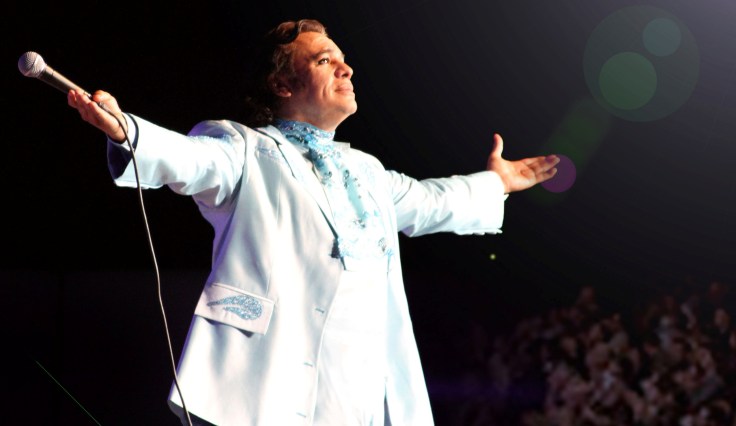
Juan Gabriel has been trading on his lifelong success for the past couple years, but you can’t say he was coasting when he died last Sunday. On August 19th he’d embarked on a tour, playing his final show a week later at the Los Angeles Forum, capacity 17,500. In some ways he was more popular than ever. On Billboard‘s Top Latin Albums chart, he had just scored a record fourth #1 album in the past 18 months with Vestido de Etiqueta por Eduardo Magallanes, an album of ornate remakes of his old songs. (The new intro for the already elaborate groover “No Quiero” now approaches full blown symphonic pomp rock — you expect to hear Christopher Lee start talking about dragons.) The other chart toppers included the two volumes of Los Duo, where Gabriel sang duets of his catalog with a panoply of pan-Latin stars from across different genres.
That’s where NorteñoBlog caught up with Gabriel: in a video that’s easily as mind-melting as any by Peter Gabriel, a new version of JuanGa’s 1980 12-bar-blues “La Frontera.” Crossing whatever musical borders you care to name, it features the continent’s best singer Julión Álvarez, the new Zelig of reggaeton J. Balvin, a four-bar breakdown for tuba and funk guitar, an impeccably tiled studio wall, a whole lotta eyeliner, and an uncredited gospel choir. (“I knew that if God was listening, he was listening to African American music,” Gabriel once told the LA Times.) You owe it to yourself:
But keeping JuanGa’s story in the present does a disservice to a man whose life and music affected millions of people. He was an unfathomably prolific writer, like Dolly Parton or Prince, and just as beloved a performer of his own material; a robust challenger of his fans’ sexual hang-ups, like Dolly Parton and Prince with their own fans; and he could transform regional genres into universally beloved national pop music, like — you guessed it — Bruce Springsteen. (Also Dolly and Prince.)
Here’s what some better JuanGa fans have written: Continue reading “Juan Gabriel D.E.P.”
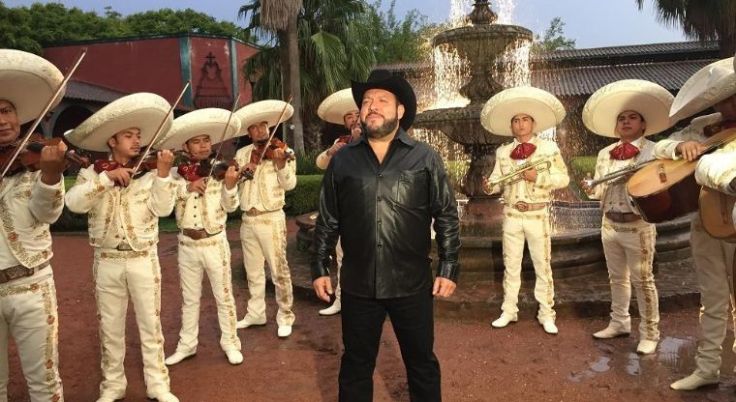
 Further down, two Remex Records acts have replaced themselves on the radio with remakes. The more notable is ace flarer-of-nostrils Edwin Luna and his banda of second fiddlers, La Trakalosa. Given our troubled and uncertain times on both sides of the Great Wall of Trump, NorteñoBlog finds comfort in watching Luna grimace his way through another extravagant video meant to highlight his perennially nascent acting chops. (He acts in both color and black and white!) No hay nada nuevo bajo el sol. “Dos Monedas” was previously a hit for Ramón Ayala, and it was written by Jesse Armenta — You know him! He wrote some political barnburners for Los Tigres, including “El Circo,” thus winning himself a chapter in the book Narcocorrido — and it’s another heartbroken sob story.
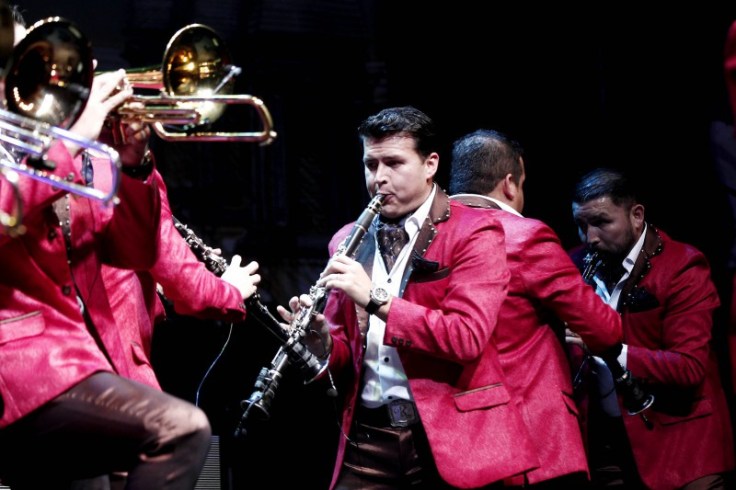
 It is the longstanding position of NorteñoBlog that the puro sax styles of Chihuahua and Zacatecas would improve with the addition of more terrible “sax” puns in the titles. First things first: La Maquinaria Norteña, the Zaca-huahuan/New Mexican quintet that stands astride this genre like a saxophone colossus, has just released its ninth-I-think album in a decade, Generación Maquinaria Est. 2006 (alternate title: Saxo de Cumpleaños). Thanks to some major label Fonovisa distribution, and because they’re on the scene like máquinas saxuales, they sold
 Afortunadamente, the job of “young dreamy norteño singer with enviable hair” is not so hard to fill, and this week’s charts have two hopefuls squeezing through the Coronel-shaped void. At #20 on the Regional Mexican radio chart is L.A.’s teen corridero

 Un ejemplo: the accordion-slinging corridero Martin Patrón (aka Martin Lopez “El Patrón”) has just released his debut album Trap Corridos, hustling another term of art from U.S. rap. It comes only a decade and change after T.I.’s Trap Muzik, but whatever; the word “trap” still has currency in this year of “Panda.” Also like “Panda,” my transcriptions of Sr. Patrón’s songs remain sketchy-to-nonexistent, but a round of Hasty Cartel Googling reveals “M100” is probably about a Sinaloa Cartel honcho, and “Hijo de Joaquín” is probably about El Chapo’s kid. (St. Louis pride being what it is, arguments for the late Joaquín Andújar, himself no stranger to hustle, will be entertained.)
 Except — here’s respectful disagreement part 2 — this album is so bad.


 NorteñoBlog