Back in April at Seattle’s Pop Conference, I presented the paper “Selena, Ariel Camacho, and Two Tragedies that Reshaped Regional Mexican Music.” Now I’m happy to report that the website Remezcla has published a streamlined version — down to under 2,000 words, from an original length of 3,000+ — with the new headline “The Tragic Artist Deaths that Reshaped the Future of Regional Mexican Music.” I have trouble boiling down the thesis for people (you can read the abstract here), but it’s basically: Selena and Ariel Camacho both died young; one of their genres fizzled out; one of their genres got big; figuring out why tells us stuff about Regional Mexican audiences. There’s also some backstory on how Regional Mexican formed in the first place; for more, see the Blog’s original research and nursery rhyme.
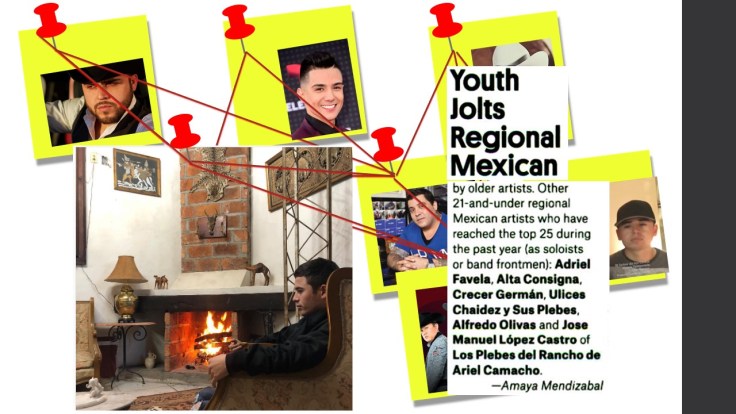
If nothing else, you should check out Remezcla for the original art of Alan López. Don’t miss his exploding keytar! However, when I changed formats from PowerPoint to thinkpiece, I had to abandon some of my beloved slides. See if you can piece together the argument from these images:


Yeah, me neither.
Finally, good news for the Blog’s readers: Remezcla music editor Eduardo Cepeda has been running more articles on Regional Mexican music, including his own (that’s in addition to his crucial reggaeton series Tu Pum Pum) and those of Roberto Jose Andrade Franco and Lucas Villa. Add in some pieces from my Singles Jukebox colleague Juana Giaimo and many many others, and that’s a website! I’m honored to appear in their company.

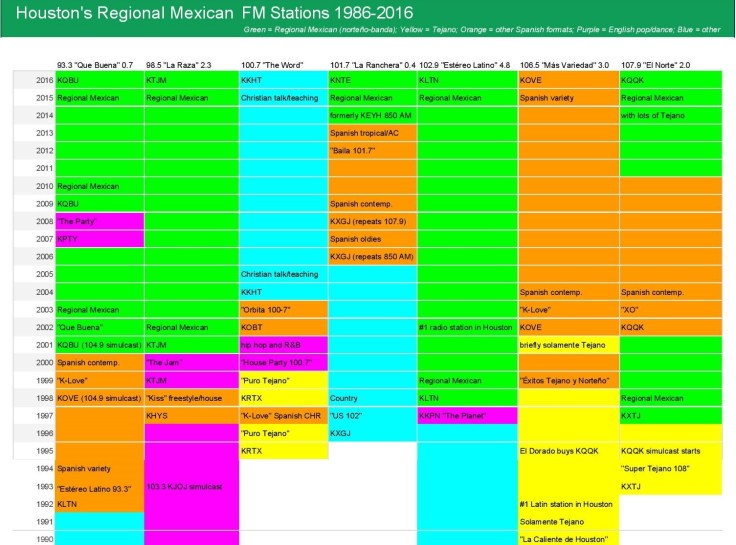
 In 1995 the 23-year-old Tejano singer Selena Quintanilla died at the hand of her fan club president. She was already the biggest act in Tejano music, itself the hottest sound on the U.S. radio format known as Regional Mexican; but in death, Selena became a household name. Her posthumous bilingual album, Dreaming of You, debuted atop the Billboard 200 and became the best-selling Latin album of all time. A generation later Selena remains an icon, but the same cannot be said of Tejano music itself. “Tejano Market Hits a Lull,” read Billboard’s ominous 1997 headline, and in 1999 the Houston Press reported, “The Tejano scene is all but gone.” Over the ensuing decades the Regional Mexican format would turn to other sounds — most recently sierreño, an austere style that exploded in popularity after a different twenty-something singer, Ariel Camacho, died in a 2015 car accident.
 After these styles’ respective stars died, why did keyboard-led, pop-friendly Tejano fade from the airwaves but sierreño — a drumless genre propelled by ornate tuba lines — became inescapable? To learn why, I’ll examine the aesthetic and commercial trajectories of both styles and the evolving Regional Mexican audience. I’ll also explore how the U.S. infrastructure for Mexican-American music has developed. Central to this story is the man who discovered Camacho, Ángel Del Villar, the owner of DEL Records and the person who realized modern sierreño could be viral youth music. Since Camacho died, Del Villar has kept the singer’s band going with two different replacement leaders; he’s also seen norteño stars like Gerardo Ortiz and Calibre 50 hop aboard the sierreño bandwagon. What insights do these styles’ respective death bumps give us into the machinations of the Regional Mexican industry and the identities of its U.S. audiences?



 NorteñoBlog