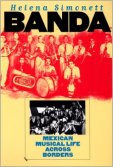
 Current reading on the NorteñoBlog nightstand is Helena Simonett’s 2001 book Banda: Mexican Musical Life Across Borders. Simonett is an ethnomusicologist at Vanderbilt University; she spent much of the ’90s interviewing banda musicians and fans around L.A. and northwestern Mexico. If you think back to ’90s banda — at least to the small extent that the blog has delved into it — the predominant sounds were the synth/horn combinations of technobandas like Banda Machos and Banda Maguey. They were sort of precursors to Chicago duranguense bands, with synths replacing horns and fewer members than a typical Sinaloan brass band. The venerable acoustic Banda El Recodo was respected and toured internationally through the ’90s, but it didn’t have much of a presence as pop music. Now, along with a host of other acoustic bandas, it does, and the technobanda sound has all but disappeared. One of the blog’s ongoing goals has been to learn how the current banda sound — classic acoustic brass bands playing newly written pop tunes — took over the radio.
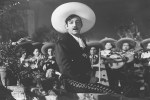 As told by Simonett, this history is complex, so here’s an oversimplification. For much of its early history, banda was largely confined to the state of Sinaloa in northwestern Mexico. (How it got there is a whole other story.) Mexico’s intellectual elite, centered in Mexico City, pushed mariachi as the national music of the people — it was cultivated by radio and the national government, which required mariachi bands play the capital in elegant charro costumes. Mariachi musicians still weren’t rich, but their string-based folk music was considered more noble and sophisticated than that of the bandas, even when the ensembles were playing many of the same songs. The difference? “Sinaloan intellectuals had never considered regional banda music folk music,” writes Simonett. “It was never the focus of interest, never presented as a tourist article, and never used for national political purposes… It evolved in the shadow of the periphery.”
Simonett includes an amazing 1926 article, written just a few years after the revolution, from a newspaper in Sinaloa’s port city of Mazatlán. The article’s author praises Mexican folk music because it jibes with his romantic notion of The People. (“The national soul has not yet died.”) But the guy hates banda. He writes sarcastically of its “hullaballoo”, “It sounds better to the ears standardized by the vibrating vertigo of the locomotives and electric trains and of the machinery of the factories.” Notice how Dylan Goes Electric that argument sounds: loud music that sounds like the city can’t be the authentic voice of the people! Too vulgar! Too commercial! Although I should note, banda was no more “commercial” than mariachi at that point.
Bandas would soon try to change that. Continue reading “Money, Innovation, and Resentment: Helena Simonett’s “Banda: Mexican Musical Life Across Borders””

 — At #9, Pepe Aguilar has invited his daughter Ángela sing backup on the lickety split banda tune “Nada de Nada,” written by José Luis Roma of the bro band
  — At #8 we find the latest Very Important Video in Edwin Luna‘s crusade to become a famous actor, fill the world with brotherly love, and get real boned.

 Beto Cervantes D.E.P.
 El Karma Karma Karma Comes Back to You Hard
 Trap Is Hyphy and Hyphy Is Trap
 Top 5 W.T.F. Corrido Moments!
 Also — and be sure to pour one out for the late George Michael, who inspired the name of this feature —
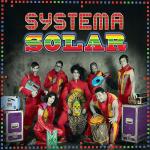 3. Systema Solar – Systema Solar (Nacional): This Colombian crew has about as much to do with norteño as Lil Jon does; but on the other hand, they sometimes play cumbias, Mexican-American radio digs cumbias, and this career overview of explosive raps and minimal dance experiments is undeniable. Plus one of the dudes says “Yeah!” exactly like Lil Jon — who incidentally scored his own Latin hit in 2016.
 5. El Komander – El Komander 2015 Top 20 (Twiins): To cap his year as North America’s most prolific and consistent singles artist, Alfredo Riós dropped this digital playlist to ring in 2016. How prolific is he? Top 20 actually contains 21 songs, and Sr. Riós has since released even more essential singles, notably
  11. Banda Rancho Viejo de Julio Aramburo La Bandononona – La Bandononona en Mi Rancho (Disa):
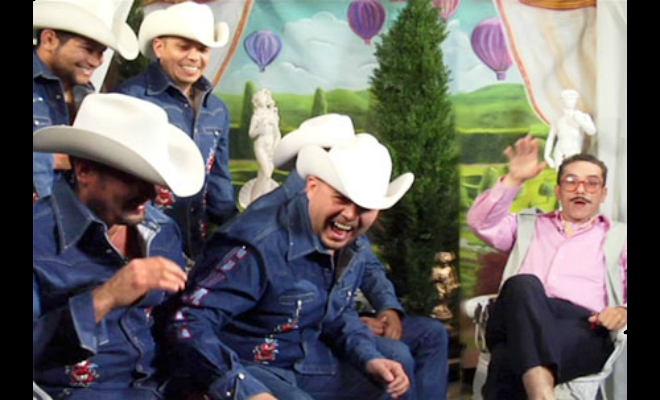
 As you’d expect, the Dallas saxtet La Energia Norteña has far more energy. They’ve just released their fifth album for the Azteca label, an ode to saxual endurance entitled No Hay Quinto Malo. And, because the fifth time’s the charm, the album debuted at #1 on Billboard‘s Latin Album chart. Lead single
 NorteñoBlog has long neglected the Sinaloan quartet-con-tuba Voz de Mando, despite their having one of the


 NorteñoBlog